Daily Signal Archive
The Value Signal — daily healthcare value intelligence briefings
The Value Signal — October 20, 2026
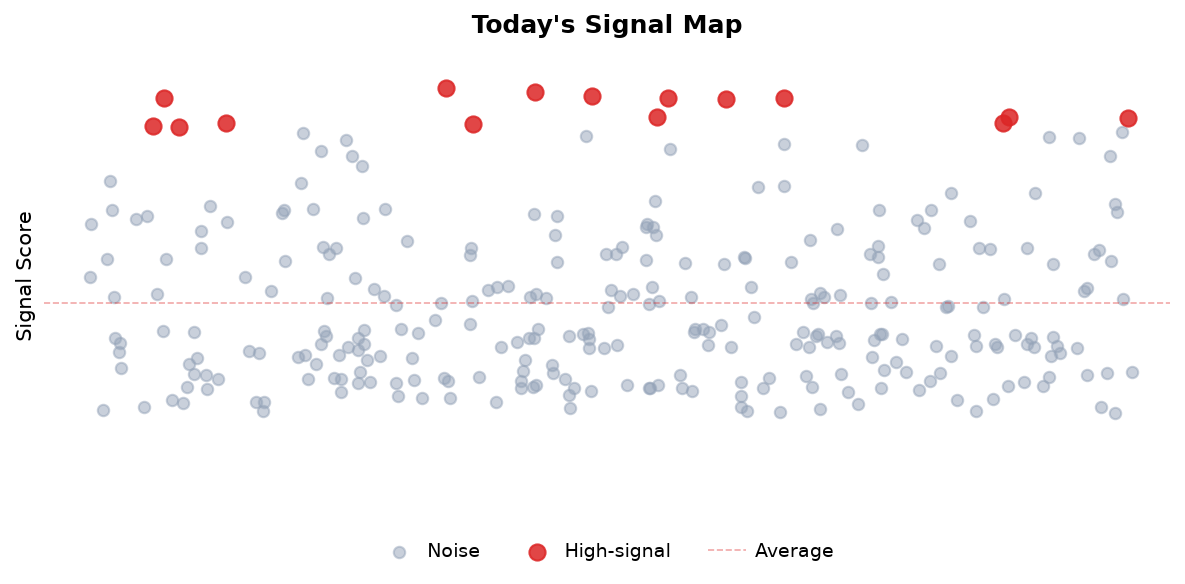
459 articles scanned · 15 high-signal
Signal Map
Executive Summary
CMS is tightening the screws on Medicare Advantage transparency and fee-for-service payment at the same time, even where value-based models have already proven they save money.
On Episode-Based Payment, Techy Surgeon reports that BPCI Advanced saved Medicare roughly $800 million and CJR another $180 million, with surgical episodes delivering the largest per-episode savings. CMS is nonetheless moving to cut surgeon payment, a signal that demonstrated value does not protect specialists from fee-schedule pressure. That pressure extends to Specialty Coding: Medical Economics examines how unbundled maternity care codes could reshape OB/GYN reimbursement in 2027. On the CMMI front, JAMA scrutinizes how accessible publicly posted kidney transplant waitlist criteria are under the IOTA model, raising questions about whether mandatory models are delivering the transparency they promise. Meanwhile, Premier notes that health system leaders set seven strategic priorities at Breakthroughs 2026, as executives recalibrate against this shifting landscape.
Medicare Advantage Oversight is sharpening on multiple fronts. According to the American Hospital Association, CMS has proposed rules targeting MA provider directory accuracy, PBM transparency and drug costs. Forvis Mazars flags a new cost report requirement forcing hospitals to disclose MA negotiated rates. Health Affairs poses the blunt question of what Medicare is actually paying for in MA, while Aledade lays out the structural differences between Traditional Medicare and MA that providers must navigate. Growth is migrating toward Special Needs and Integrated Plans: Modern Healthcare calls SNPs MA's next golden goose, and OPEN MINDS reports that Rhode Island is seeking up to three plans for an integrated Medicare-Medicaid program, alongside Star Ratings data showing that 71% of MA prescription drug plan enrollees will be in four- or five-star plans for 2027. In Risk Adjustment, Becker's Hospital Review observes that AI is shifting from point solutions toward enterprise-wide operational efficiency, a pivot that will draw closer scrutiny as payment integrity enforcement intensifies.
In this edition
- Bundled PaymentWhy Some Hospitals Send Surgical Patients Back to Their Family Doctor and Others Don’t — Bioengineer
- Quality MeasuresSepsis Rules, Real Patients: When Quality Metrics Collide With Clinical Judgment — Bioengineer
- Star Ratings71% Of Medicare Advantage Prescription Drug Plan Enrollees In Four- Or Five-Star Plans For 2027 - open minds — OPEN MINDS
- MedicareTraditional Medicare and Medicare Advantage: Understanding the differences — Aledade
- MedicareCMS issues proposals to improve MA plan provider directory accuracy, PBM transparency requirements and reduce drug costs — American Hospital Association
- MedicareHealthcare Brew | Healthcare Industry News & Trends | Healthcare Brew — Healthcare Brew